Why Bathroom Falls Happen
The bathroom combines three conditions that independently raise fall risk: wet or slippery surfaces, confined movement, and position changes such as sitting down and standing up. Among Canadians aged 65 and older, roughly one-third experience at least one fall each year, and bathroom incidents represent a significant portion of those events according to data from the Public Health Agency of Canada.
The positive side is that bathroom falls are among the most preventable. A targeted set of modifications — centred on grab bars, flooring, and fixture height — addresses the majority of risk factors without requiring a full renovation.
Grab Bar Types and Materials
Grab bars are not a single product. They vary considerably in diameter, finish, load rating, and mounting style. Choosing the wrong type for a specific location can reduce effectiveness or create a false sense of security.
Diameter
The Accessible Canada Act references CSA B651 as the applicable standard for accessibility in federally regulated buildings. For residential use, most occupational therapists recommend a grip diameter between 32 mm and 38 mm (1.25 to 1.5 inches), which suits the widest range of hand sizes and grip strengths. Bars narrower than 28 mm tend to feel unstable; bars wider than 44 mm are difficult for people with reduced hand strength to close their fingers around.
Load Rating
A grab bar should support a minimum outward load of 1.3 kN (approximately 290 lb) at any point along its length when tested under CSA standards. Consumer-grade bars sold at hardware stores typically advertise a 250 lb rating, which is adequate for most applications, but anchoring into wall studs or using toggle bolt systems rated to match is equally important.
Finishes
Stainless steel and chrome are common and easy to clean. Satin nickel reduces glare and blends with most Canadian bathroom fixtures. Some manufacturers produce bars in a matte white or bone finish specifically to make them less visually clinical — an important factor for older adults who resist modifications that make their home feel like a care facility.
Colour contrast between grab bar and wall surface helps users with low vision locate the bar quickly. A difference of at least 70 points on the Light Reflectance Value (LRV) scale is the commonly cited threshold.
Placement Standards for the Toilet Area
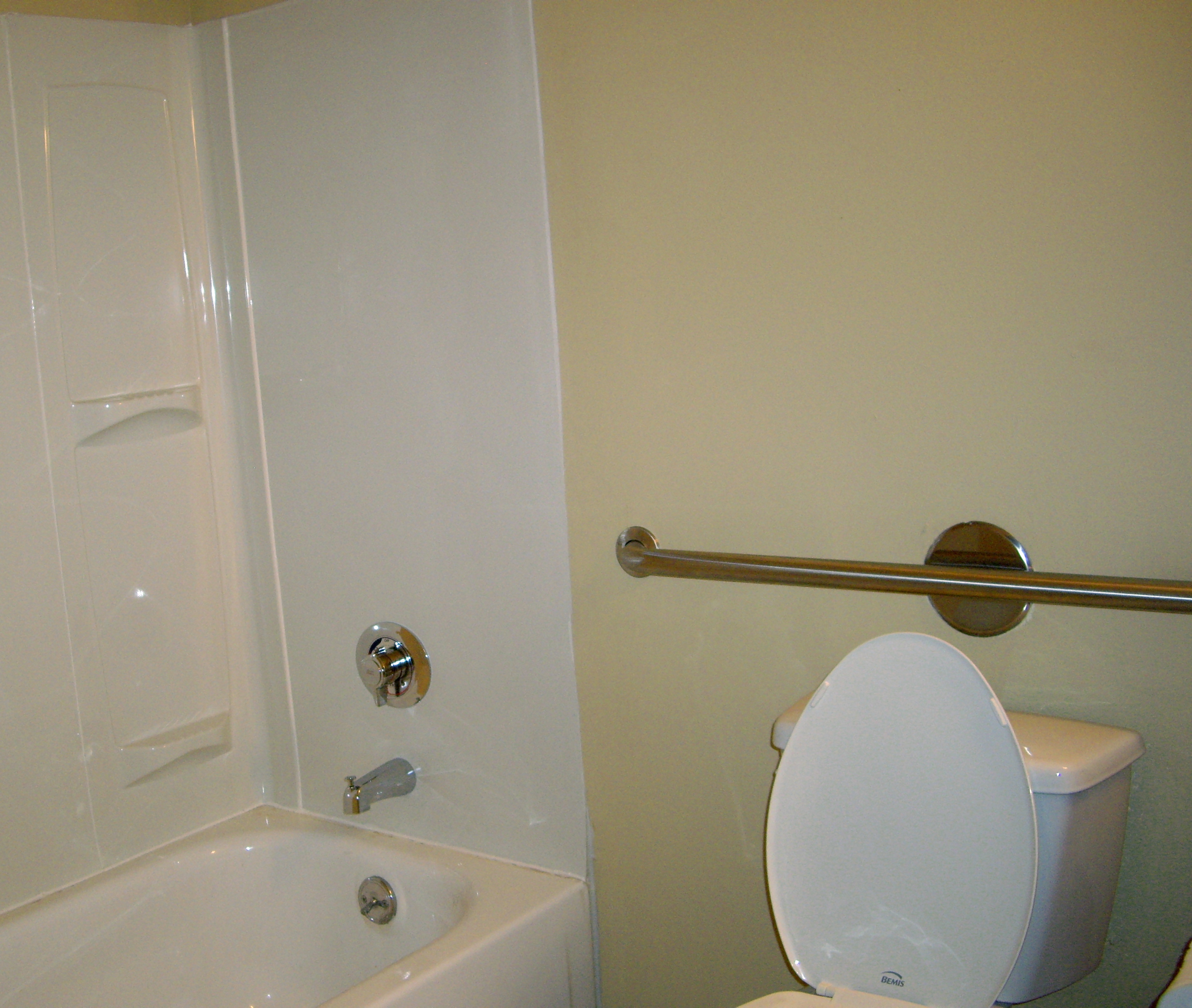
The toilet is the single location where a properly placed grab bar delivers the greatest measurable benefit. Three positions are most frequently recommended by Canadian occupational therapists:
- Side wall bar: Mounted 6 to 8 inches in front of the toilet's front edge, at a height of 33 to 36 inches from the finished floor. Angled bars (typically 30 to 45 degrees) allow a downward push for standing and a horizontal pull for lowering.
- Rear wall bar: Centred on the toilet, 33 to 36 inches from the floor. Useful for users who need support during the seated position itself.
- Swing-down bar: A hinged bar that folds against the wall when not in use — the preferred option when bathroom width is limited or when multiple people share the space, only some of whom need the bar.
Shower and Bathtub Modifications
Shower modifications range from a single grab bar to a complete roll-in conversion. The most common intermediate option is a walk-in shower threshold — reducing the existing curb from a 4-inch step to a 0.5-inch bevelled edge. This requires waterproofing work but typically does not involve moving the drain or any plumbing.
Grab Bar Positions in the Shower
- Entry bar: Vertical or angled, positioned at the shower opening at a height of 34 to 48 inches — used for stepping in and out.
- Interior horizontal bar: 33 to 36 inches from the floor, on the wall opposite the showerhead — used while standing and rinsing.
- Diagonal bar: Running from approximately 18 inches from the floor on the short end to 40 inches on the upper end — supports both sitting on a bench and rising from it.
Shower Seats
A fold-down shower seat is the most space-efficient option for a standard 36 x 36-inch shower stall. It should be positioned so that the seat surface is 17 to 19 inches from the finished floor — matching the ADA/CSA B651 range that most people can lower onto without significant hip flexion difficulty. The seat should be rated for at least 250 lb and mounted into studs or a blocking system installed during renovation.
Non-Slip Flooring
The coefficient of friction (COF) is the standard metric for slip resistance. For wet bathroom floors, a dynamic COF of 0.60 or higher is the generally accepted minimum for residential safety. Standard glazed ceramic tiles typically measure 0.40–0.50 COF when wet, which falls short.
Options that meet or exceed the threshold without requiring full re-tiling include:
- Anti-slip adhesive strips applied to existing tile (effective but require replacement every one to three years)
- Anti-slip coating products applied by brush (more durable, rated to 3–5 years depending on product)
- Rubber or vinyl non-slip bath mats with suction cups (require weekly cleaning to prevent mold growth underneath)
- Porcelain tile with a brushed or matte texture during renovation (the most permanent solution)
Toilet Height and Raised Seats
Standard toilet bowl height in Canada is 14 to 15 inches from floor to rim. Most occupational therapists recommend a seated height of 17 to 19 inches for adults who have difficulty with hip flexion or knee pain — this reduces the muscular demand of sitting and standing by roughly 20%, according to rehabilitation research published by McMaster University.
Three options address this without replacing the toilet:
- Raised toilet seat (bolted): Adds 2 to 6 inches; the bolted variant is significantly more stable than the clamp-on type.
- Toilet safety frame: A freestanding frame with armrests that also adds lateral support; useful in situations where wall mounting is not possible (rental properties, for example).
- Comfort-height toilet: The permanent solution — at 16 to 18 inches rim height — for those undertaking a full bathroom renovation.
Lighting Improvements
Bathroom lighting is frequently overlooked in modification discussions, though it directly affects both fall risk and the usability of installed grab bars. The recommended minimum illumination level for bathrooms is 500 lux at counter height and 300 lux at floor level. Night-lights positioned at floor level — visible from the bedroom corridor — reduce the number of disorienting middle-of-the-night trips to the bathroom in low light.
Motion-activated switches eliminate the need to search for a switch in the dark. Several Canadian electricians' associations note that these can be retrofitted to existing switch boxes in most homes built after 1980 without rewiring.
What Occupational Therapists Assess
A home modification assessment by a registered occupational therapist (OT) covers bathroom use in detail and typically results in a written recommendation letter that can be submitted to some provincial funding programs. In Ontario, for example, the Home and Community Care program may fund OT assessments for eligible individuals. British Columbia's Community Living BC and Alberta's Seniors Home Adaptation and Repair Program (SHARP) offer direct funding for installation costs in qualifying cases.
The OT assessment typically takes 60 to 90 minutes on site and produces a prioritized list of modifications, their estimated cost, and — where applicable — the names of suppliers or contractors familiar with the relevant standards.
Installation Considerations
Grab bars anchored only into drywall will fail under load. The standard approach is to anchor into wall studs (typically spaced 16 inches on centre in Canadian residential construction) or to use a steel-backed blocking panel installed behind the wall surface. Blocking panels — 3/4-inch plywood rated for moisture — can be installed in advance of knowing the exact bar placement, which is useful for bathrooms where future modification is anticipated.
Some bathroom walls, particularly in older homes in Toronto, Vancouver, or Montreal, use tile over a mortar bed rather than backer board and drywall. In these cases, drilling requires a tile bit and a different anchor system. A contractor with renovation experience in older housing stock will have encountered this and can advise on appropriate fastener choices.